
The four relations in Aesop's fables
A continuing examination of the cultural representation of animals.
Ely Tahan
5/2/20262 min read
In Aesop’s moral tales featuring animals four relational structures can be discerned:
- The relationship between the animal protagonists. Paired by reason of their contrasting nature.
- The relationship of the animals to a common object. Often food whose handling determines their behavior.
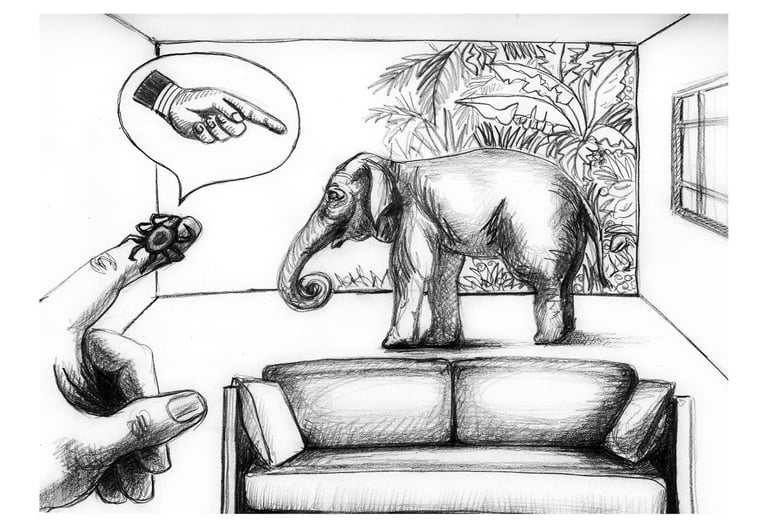
- The relationship between us and them. The factor that is not mentioned, as it is absorbed by the animal personalization.
- The relationships among humans themselves. The main subject and intent of the moral fables.
The first relationship exists between the protagonists themselves, who are deliberately paired to highlight their traits in almost binary opposition: the courageous lion confronts the timid mouse, the fast hare races against the slow turtle, the cunning fox outwits the naive crow. These anthropomorphized creatures serve as vessels for distinctly human characteristics, embodying virtues and vices that reflect our own behavioral spectrum. Consequently, the mimetic element by which animals inform human subjectivity within a sphere of mutual influence is harnessed by a taxonomy that confers specific human traits to a selected and exemplified aspect of the living animal: the courageous lion, the slow turtle, the cunning fox, the self-righteous ant and so on.
The second relationship centers on the animals’ connection to a common object - most frequently food – which serves as a catalyst for their actions and interactions. This object operates as a neutral motivator that reveals the different approaches and strategies each character employs in their pursuit of it. The cheese in "The Fox and the Crow," the grapes in "The Fox and the Grapes," or the bone in "The Dog and His Reflection" all function as a desirable commodity that remains fundamentally unchanged, an object latent in itself and unaffected by who appropriates it. The fox and the crow squabble over the cheese but it could have easily been another substance. Thus the sole recognized characteristic of the fought-over object is that it is desired by both.
The third relationship – the connection between humans and animals – remains conspicuously absent from these narratives. This omission serves as a smokescreen that conveniently sidesteps the fraught history of human-animal interactions. The cruelty humans have inflicted on animals may not have been as pronounced in earlier times, given many of the fables’ idioms are handed down from antiquity, but the level of exploitation in the last century alone casts a long shadow on the innocence of their intent. The absence of the human-animal relation is replaced by the animal actor which in turn is a mere stand-in for the human agent. In reality, the possibility of truly mutual human-animal engagement is overrun by a double articulation whereby humans hold animals close by domesticating and farming them or at a distance in wildlife reserves, if not showcased in a zoo.
The fourth relationship concerning human interactions constitutes the explicit purpose and traditional subject matter of the fables. With animals impersonating humans in exotic settings, the prescriptive message creates a safe distance that allows for uncomfortable truths about human nature to be confronted indirectly. But although the tales are instructive and pedagogical, they are also loosely judgmental and as such have been subjected to irony and reversals. Suffice it to say that while making light use of allegory, their behavioral messages are clearly recognizable and overshadow anything that might transpire from the other above-mentioned relations. In this relationship, everything remains virtual while the moral prescription is astutely embedded in projections, subsuming the first two relations and completely leaving out the third.
Explore the artworks
of Ely Tahan on social media:
CONTACT
© 2025. All rights reserved.