
Paralogical Zoo
New work in progress.
Ely Tahan
4/28/20264 min read
The dominant treatment of objects in contemporary culture complies with an attitude that has shaped our understanding of reality for centuries. This framework, inherited from the history of European thought establishes a rigid hierarchy that privileges the human subject while subordinating the material world to human purposes. As Hannah Arendt argues in the “Human Condition”, objects serve as stabilizing forces in an otherwise unsettling existence. Against Heraclitus’ famous assertion that we cannot step in the same river twice, Arendt posits that humans in spite of their changing nature, can recover their identity in how they relate to the same chair, the same table and the same plate. Thus while objects provide stability and continuity amid human flux, this ontological determination strictly opposes subjectivity to worldly objectivity.
Despite its humanistic intentions in resisting totalitarianism, the privileged status of the human subject was destined to be challenged and eventually unmoored from its unquestioned seat of power. Arendt reveals that an allegedly neutral position she identifies as the point of Archimedes, is the lever from which humans believe they can observe and manipulate the world objectively. This very detachment, however, becomes the root cause of the exceptionalism that imposes a hierarchal structure on the immanent course of events, arranges fauna and flora according to a comprehensible pecking order and arbitrates the distribution of agency by distinguishing between living beings and inanimate things. This hierarchal thinking has had particularly devastating consequences when applied to human relationships themselves. The same logic that allows humans to position themselves as masters of the objective world has historically enabled the subjugation of other humans, most conspicuously in systems of slavery.
Chief among the attributes of the measure of all things is the exclusive ability to develop language. The sapient animal wields its yardstick over all phenomena and slips into the fallacy that thought equals world. This linguistic solipsism reaches its apotheosis in the digital age, where the boundary between language and reality has become perilously thin. The modern prompt, whispered into the void of a machine learning model, becomes a creative act that rivals divine fiat. With textuality replacing history, the human subject is locked in the ivory tower from which it pronounces the order words that terraform reality. The talking points of politicians concretize this high jacking of objectivity with the verbal instrument of propaganda and the post-truth era is a direct manifestation of how narrative power distorts the objectivity of events. To the arrogant conviction that the world is just a text to be read, and consequently rewritten, is the fact that language has become pervasive in even more self-effacing ways, for if our cognitive landscape was already saturated by the syntax of advertisement and merchandising, the emerging paradigm is one in which language at its most intrusive is paradoxically absent.
The countercurrents against this linguistic imperialism foster a profound change of paradigm in which language is not a universal medium that imposes its structure on the world but is situated on the surface of things and extracted from the fold of events. In this mode of operation, words and sentences are not issued from a platonic alphabet but bend to the particular contour of bodies and orbit their parent objects like dutiful satellites. This perspective finds resonance in indigenous epistemologies that never separated language from land, in phenomenological approaches that emphasize embodied perception, and in ontologies that foreground the agency of non-human actors.
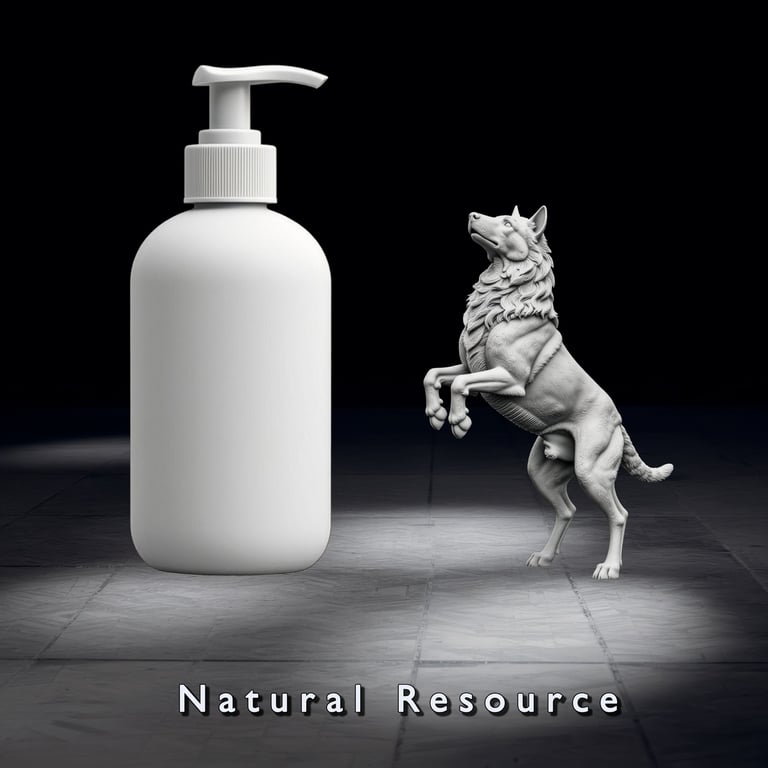
Paralogical Zoo is the title of a body of work that operates at the intersection of three domains: consumer production, animal representation and language generation. The art object results from the amalgam of elements proper to these schemes or modes of operation. Elements deemed natural or artificial but inscribed in a flat ontology that does not oppose them. The works delineate a liminal space in which reasoning operates alongside, but not within, the strict confines of formal logic. It is a logic of the messy in-between, the contingent and paradoxical relationships that constitute actual experience. While the compositions operate within the minimum requirement for the production of metaphor, the use of generic and commonplace objects questions the primacy of the human subject and its use of art as a means of self-expression. Deliberately employing objects that lack the aura of uniqueness or artistic pedigree, the series dismantles the hierarchal structures that privilege human authorship. A plastic bottle, a discarded tire, or a common houseplant, when placed in conjunction with an animal form and a linguistic fragment, generates a meaning that is not authored but discovered – an emergent property of the encounter itself. The act of creation that arises from the intersection of non-proprietary elements parallels the use of language conceived as a collective repository of objects. Meaning is co-authored in an inter-objective process making the linguistic component in these works, not a caption or an explanation but an equal partner in the assemblage. It functions not to clarify or to symbolize but to add another layer of materiality, another texture to the encounter.
Here then, the measure of all things untangles its anthropomorphism from the slippery slope of exceptionalism, for the human as an ingredient is no more or less important than what it engages with. This leveling of the ontological playing field does not diminish human experience; rather, it enriches it by connecting it to a vast network of non-human processes that constitute our world. To properly experience these works, the audience is invited to incarnate a subject that is ensconced between what is given to it and what it instrumentalizes, bridging the encounter with the verbal component of the amalgam. Idiosyncrasies may arise from the ocean floor of these hybrid encounters but a more pertinent distinction comes to the fore. One that does not constitute a fundamental difference between nature and artifice but rather recognizes degrees of taming wilderness.
If a Zoo is a containment of wilderness, its entrapment applies to objects as well. Animals domesticated by their representations find their counterpart in objects disengaged from mere utility. And if logic is the guiding principle of the measure of all things, the paralogical is what places it in the context of their particular encounters, widening the framework of possibility. The incompossible now persists where there was only impossibility. For while humans have exploited animals, commodified objects and developed the language to justify it all, animals have outgrown their behavioral farms and objects, their alleged neutrality, to run free in their shared forestry.
Explore the artworks
of Ely Tahan on social media:
CONTACT
© 2025. All rights reserved.