
Mineral Resistance
Thoughts on the war in West Asia, social media and cultural hegemony.
Ely Tahan
5/12/20268 min read
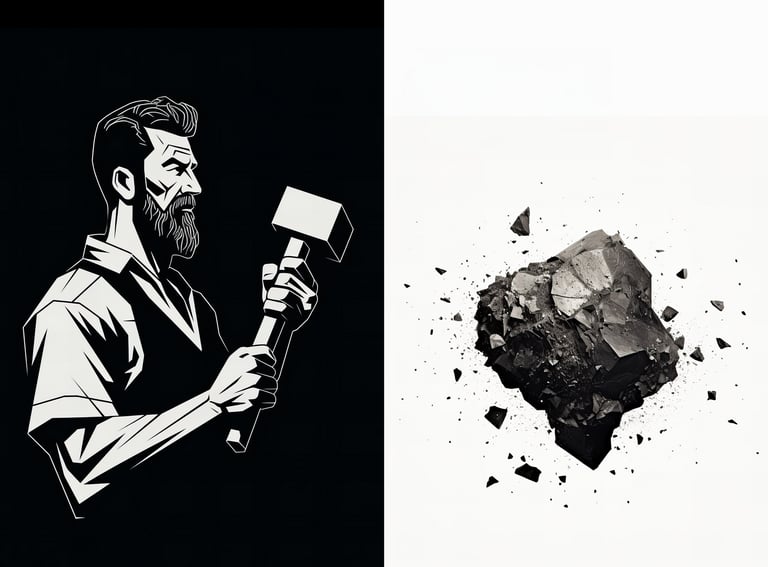
It is notable that the alien in a recent science fiction movie is neither humanoid nor animal, not even vegetal in nature but distinctly mineral. Described as “rock-like” in reviews of Project Hail Mary (released in 2026), the extraterrestrial is nevertheless endowed with five limbs that differentiate it from the inertia long ascribed to the mineral realm. Despite the residual anthropomorphism that bridges it to the human dimension, “Rocky” represents a milestone in reversing an order that has imposed a strict hierarchy on the spectrum of living things. It comes as no surprise that the unraveling of this dominant ontology extends to its foundational premise—a determination with two related ends: the inertness of base matter and the passivity of objects.
The opposite holds true regarding current political affairs that are destabilizing the planet to the point of an unprecedented rupture with its own indigeneity. The US military complex and Zionist ideology are the tumorous growths of a metastatic ordinance, all the more virulent because it has no future. The way this tandem has advanced its nefarious aims in West Asia, ever since its old-world orientalist roots, has neutered the peculiarities of the terrain and its organic demographics into a Terra Nullius, ready for the taking. The total disregard for geography aligns with the colonialist treatment of land. It comes as no surprise that the parasitic economy founded on the exploitation of its resources is haunted by choke points —consequences of an inveterate materiality that ultimately condemns the appropriative enterprise to perpetual crisis.
The association between these two observations— or perhaps more fittingly, the disparity one is left with when considering that mighty cultural ideals flourish under the wings of violent empires, that artists thrive in the self-effacing protectorate of ruthless orders— brings into focus the dubiousness of what is termed “civilization”. We are reminded of the warning issued by a US envoy to non-compliant factions in Lebanon, chiding them to curb their “animalistic behavior”. The principle touted as civilization is responsible for the worst atrocities, aids and abets genocides while its unsuspecting denizens promulgate emancipated criteria, voice ecological concerns or produce correctives to their age-old dogmas in Hollywood movies. Secretary of State Marco Rubio can, with the clearest conscience or absolute lack thereof, declare that the only obstacles to peace in war-torn West Asia are the resistance groups that continue to push back against their exploitation. The Trump administration having reached new heights in gubernatorial gangsterism, is gathering immense criticism from liberals and democrats who, if push came to shove, would be more protective of the global aims of US empire. Yet the unpleasant truth is that the current president is an unforgiving expression of a culture that refuses to look at itself in the mirror—a denial that makes the reflection all the more unflattering. Admiration, as in the cautionary fairy tale, is the fatal deed that makes the mirror eventually betray its beholder. But no matter how endowed with authority, the uncouth personalities of Trump and Netanyahu are only there to distract and ensnare. For the political die was already cast by the historical processes bracing the specific geography of West Asia. If it is coming back to the fore with a vengeance and irreducibility that is a serious affront to the dollar economy, it is in tandem with the deep-time sedimentation that makes Iran the last remaining bulwark of indigeneity in the region. The retroactive temporality—time insisting on a granular permanence despite its inexorable progression—parallels the region’s spatial fight for self-determination. This is a momentous quickening of historical processes shifting the cultural plates of the region. But for the self-proclaimed group of pirates at the helm of empire, Iran remains the target of relentless aggression, and because it rejects the very notion of their virgin territory, it is viciously flattened into a go-to dart board whose bull’s eye remains the liberation of Palestine. To convey the complexity of the ongoing situation, it bears mentioning that the US/Israeli war of aggression on Iran is fully supported by the European union, which is also caught in this convulsion of space and time. An evident reason is Europe’s age-old orientalism and deep-set hostility to Islam, but perhaps it is also because its repentance for much of its colonial past falls short of avoiding the same hubristic overruling of geography that pawns the Ukraine in a war against Russia.
The systematic erasure of the past by the “civilizational” forces is in full force as they normalize the murder of journalists and paramedics to eradicate any form of resistance to their expansionist designs. It is staggering to what extent this enterprise has been allowed to implement its nefarious aims in Palestine and Lebanon. A Kushner and a Witkoff are the shallow cut-outs in a Potemkin village of utopian capital intended to flourish in the ashes of a scorched Gaza, but behind them stretches a historical blueprint of laundering genocide. Whitewashing massacres with real estate development is the elementary logic behind the cauterized elimination of America's entire native population. The grand narratives of western culture may seem removed from crude settlement and development, but the Renaissance and the Enlightenment are no different in respect to the radical break they impose on the organic continuity of events, vaporizing the entire middle ages in textbook entries. The same could be said of Modernism with its radical cessation from tradition, and of Post-modernism as well, for its meta-denegation of objective reality. Zionist ideology aligns perfectly with these intellectual and cultural methods and has made ample use of them in their propaganda to exercise their God-given right to rewrite history according to an ecumenical edict.
While dedicated journalists in Gaza and South Lebanon are being relentlessly targeted, mainstream news channels across the world are hopelessly overtaken by the soporific talking points of mendacious leaders. Social media, demonstrably founded on advertising principles, becomes the unlikely candidate for conveying data of an unwanted kind, leaking snippets of the devastating realities on the ground. Counter-measured by draconian repression and fake news, these messages struggle to mobilize dissent amid the slew of unrelated “content” typical of the medium. The forced contiguity of cascading contexts in an avalanche of information makes continuity the exception rather than the norm, all under the guise of representing multiplicity. The ceaseless stream of information blurs the singularity of an entry and drowns it in a plethora of other messages vying for equal attention, releasing a chain of unrelated material rather than the necessary hiatus to give the entry its proper due. The haphazard having become the norm, the relatable is only an intermittent signal amidst an imbrication of contexts that parade the 99 flavors of an insipid concoction. Yet so much of modern subjectivity is grafted onto its usage, and its ubiquity is such that it has become the leader of the free world’s preferred method of communication, if Trump’s endless regurgitation of deceiving narratives can be defined as such.
A further reason for dwelling on the ill effects of social media is their indication of deeper cracks fragilizing the dominant culture promoted by western hegemony. It is important to note that all human systems of knowledge hinge on the articulation of the individual and the collective. Art, religion and politics operate at the cusp of the part-to-whole relation that manifests itself in the members of a society, the citizens of a country, the units of a constituency. Science is not any different with its practitioners drawing from and contributing back to a pool of common knowledge. The question is how these platforms of cultural exchange operate at the interface of self and other and to what ends. The social bridge is established for users to reach others through self-expression and free volition. The lure of personal fulfillment feeds algorithms that single out a preferred subject according to its popularity. The recipes for success loop back on users who become influencers, who with armies of devout followers unsuspectingly promote the algorithms’ preferential paradigms, thus doing their dirty work of rigging the probability of choices to validate the dominant narrative. Thus the way art and the body are treated on Facebook and Instagram is tantamount to a currency in an economy that instrumentalizes them with the seduction of immediate gratification. The body, if a manifold of possibility, is circulated as a commodity and art —the essential human bridge to objects—is treated as a proprietary form of self-expression when it is first and foremost a ritual, understood as the behavioral pattern that binds the individual and the collective. But ensconced in an exploitative culture, art at its cutting edge becomes an enterprise of taking credit for the unraveling of every biased determination towards the object and parallels the treatment of the body which is made to carry all the trials and tribulations of sexuality, its needs and problematics perfectly addressed by the commodity.
Geopolitical stakes have dramatically spread over ontological strata in the nearly 3 years of immense conflict since October 7th. It is difficult to fathom the implications of the current events because of a paradigm shift that is changing the framing of what and how questions are asked. This reworking of the rules of engagement is certainly a welcome corrective to the massive Zionist propaganda that pervades popular culture. The steadfast Iranian response to the US and its acolytes comes not only as vindication for the ruthless ravages inflicted by the colonial powers but also, and more importantly, ushers in the momentous possibility for the entire region of West Asia to come into its own after too many centuries of being cast as a conqueror’s orient. Everything is on the table, so to speak. Many safe assumptions have come under scrutiny and old alliances have fallen like dominoes. While it may take decades, perhaps a century for these correctives to take effect, a clear indication has emerged that the kind of uprooted detachment inflicted and promoted by western culture, is not endemic to the human condition but was an instrument of acculturation all along.
Ibn Khaldoun is remembered for advancing the notion that each thing carries within it the seed of its undoing. As such the critics of empire belong to a cultural tradition that has questioned the legitimacy of the tenets on which it is founded. The deconstructive vein initiated by Marx, Nietzsche, and Freud has spawned a counter-current to the legacy of its apologists and contributing state philosophers such as Plato and Hegel. The critical examination of western metaphysics has led to the reversal of the very biases inherent to the formation of human subjectivity, on the level of its own species beginning with the practice of slavery and in regard to the phenomenal world in which it is engaged. Immanence and a cooperative symbiotic model have been presented as viable alternatives to the pyramidal and transcendental persuasion that supports the imposition of hegemonic power. The progression of this impetus has proclaimed that the entry into the Anthropocene is accompanied by the dawn of post-humanism, a doctrine intent on reversing the ill effects of human exceptionalism in successive layers, down to the boundary of its determination of base and inanimate matter. There is a dissonance, however, when the champions of these shifting paradigms disengage themselves from a livestreamed genocide or hide behind a tapestry of arguments to evade its outright condemnation. It is a discrepancy that hangs an important question not only on their detachment but on the element of fundamental severance specific to western historical narratives. In this imaginary, a rupture from a subtending state is the event that characterizes the beginning of a new epoch, thus enacting a radical break with its past in a manner analogous to the deracinated state of its protagonists. The ushering of a new era is often followed by a return of the repressed but neither can replace the genuine voice of the other, whose discourse may coincide with or diverge from the deliberations of the critics of empire. An entity may foster without making deracination its natural condition and correlating its origin with its coercion. At this point, we could be treading ontological territory and heading into a world where the apprehension of phenomena does not obey a subject/object relation, where the possibility of simultaneity operates in lieu of opposition and contradiction, where there is no virgin territory to be claimed from a tabula rasa, and where discontinuity does not rupture connectivity, whether social or mycelial, but like a heartbeat, endows it with a cadence of its own.
Explore the artworks
of Ely Tahan on social media:
CONTACT
© 2025. All rights reserved.