
Homo homini lupus
Initial text on the examination of idioms based on the cultural representation of animals.
Ely Tahan
4/30/20262 min read
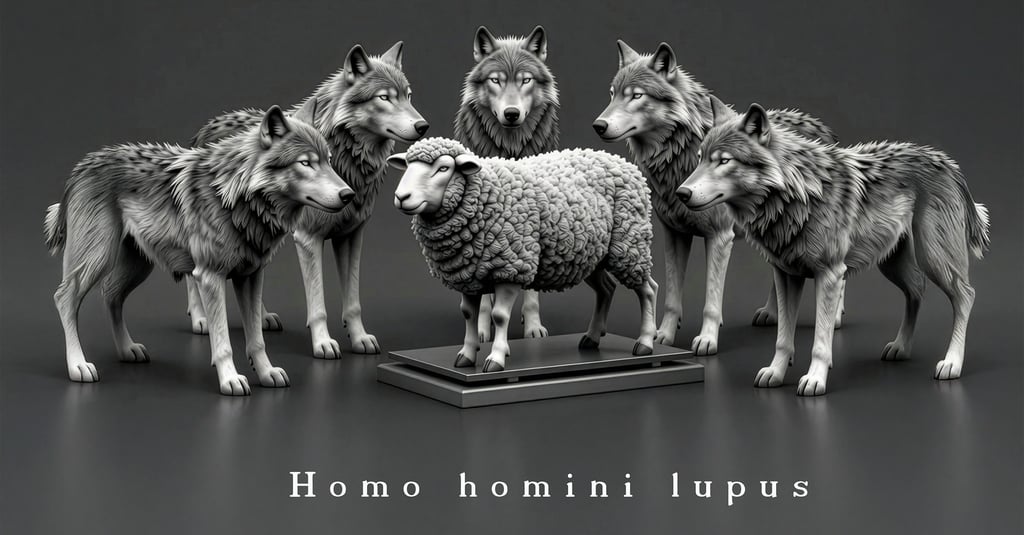
Idioms based on the representation of animals cannot evade closer scrutiny for too long, as they reveal more about human affairs than about the creatures they purport to describe.
Hobbes’ declaration that man is a wolf to man equates wilderness with hostility for a particular reason that remains conspicuously unexamined, and in tandem with his professed natural condition, is considered an incontrovertible given rather than a constructed premise.
Central to the proverb yet obscured by a blind spot, is the unquestioned human right of appropriation – a foundational assumption that renders the wolf threatening precisely because it is after the cattle that has been branded into private property. The principle that transforms the prey into a coveted commodity is occluded because it is a conversion that only occurs in the conceptual frameworks of human economic systems.
The self-effacing commodity is the real reason behind the insistence that humans are capable of the worst atrocities against each other. It certainly tells us more about the adage itself than anything of value the latter adds to understanding the wolf by pure observation. The animal is only a subterfuge for the inert commodity whose genesis begins by securing a plot of land for the extraction of the legitimate patents and products that must be protected at all cost.
The popular saying functions simultaneously as a linguistic act that distracts from its main purpose by normalizing its intent. After all, it is not a statement about the chaotic state of nature as much as a legitimation of selfishness and predation. This brings the proverb from its collective generality to the realm of individual psychology and behavior. The fear and suspicion of being betrayed by a hostile other makes it unbearable to be stripped of any personal protection against ordinary strangers, in keeping with the main blueprint which posits the internecine predilection of humankind as a universally accepted fact. Consequently, self-preservation not only operates on the collective level by making generalizations about the state of nature and wilderness - man is a wolf to man - but extends to the private lives of individuals who by analogy must contend with the surreal and anthropophagous dog-eat-dog, as they struggle to survive in a world of market competition where the commodification of human relations is a de rigueur expression of this unspoken license to appropriate.
Explore the artworks
of Ely Tahan on social media:
CONTACT
© 2025. All rights reserved.