


Hippocamp Pharmakon

Socrates, in the era of oral culture, warned against the misuse of writing by sophists, stating that it is a "pharmakon," a term meaning both a poison and a cure. This duplicitous nature ultimately leads to his own downfall when he is falsely accused of corrupting the youth. Plato's dialogues reflect this warning and the betrayal of the polis that Socrates sought to improve. The concept of health is also affected, as even the Hippocratic Oath, based on principles of confidentiality and non-harm, is not immune to the deceit embedded in the Caduceus, the staff of Hermes, the god of trickery and thieves.
In the epochal leap that brought the printing press, writing undergoes another upheaval, laced with the pros and cons of the Industrial Revolution; just as subsequently, the digital age unleashes unprecedented freedoms interlaced with technocratic abominations. Exosomatisation, the use of prosthetic extensions to tackle the acceleration induced by technology, succumbs to the forces of entropy because, although unnoticed until its quickening since the 18th century, its exacerbation with automation and robotization hurls it into the dispersion of a suicidal decline. Modern technology is thus a pharmakon where some have sought to counter entropy with the capacity of the living to evade closed systems.
We are led to a more fundamental fault line, a rift that beckons an inquiry into the nature of substance and essence, which since Aristotle have been central to the ontological structure of reality. The separation of substance from essence leads to addiction and a loss of the irreducible qualities of the object. The proliferation of images and the use of technology as a confessional and therapeutic tool further complicate the issue of locating the real outside of self-referential illusions. The limitations of phenomenology, rationality, and even religion in this respect ultimately raise the question of how to maintain the essence of the object without absorbing it into methodology.

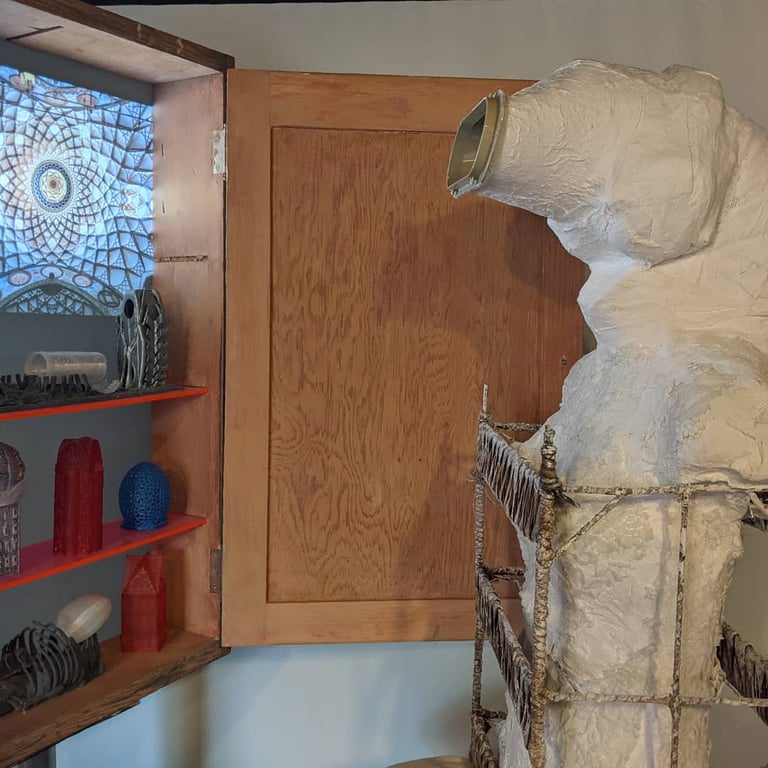
The installation portrays a self-absorbed chimeral entity that interfaces the impartiality of a surveillance system, crowning an impenetrable media fortress. The instrument that perpetrates the spatial cleavage and mediates the encounter is a medicine cabinet open to a back wall of oncoming projections, creating a display case that doubles as a personal tabernacle. The subject on the user-end is a creature holding its animal becoming in a scaffold, standing in sharp contrast to the human head circling the horizon of the visible from its monadic watchtower. The creature's limbless, amphibious body seems hatched from a metamorphosis gone awry, cowering behind the screen regulated by its monolithic counterpart. The latter, a brutalist anti-lantern outfitted with a video camera in each cardinal direction, intakes the installation site and projects it on the liminal screen, like a sinister beacon feeding the creature its coefficient of reality.
On the top of the installation, a chopping kitchen knife crowns a gauze-bandaged and confetti-covered human effigy that looms as a rotating insignia of pleasure and pain. To the glut of images and surveillance data broadcast by the inverted panopticon, a rhythmic and poetic recitation emanates from the anthropomorphic figure, striking fortuitous associations out of the contingencies generated by the meeting of the actants. The polarized determinations that cluster on the partition are numerous but remain random in respect to a radical schism, a fundamental rift between what the objects are in themselves and the qualities drawn from their interactions. The installation, hypothetically installed in the wide aisle of a busy drugstore, is strategically deployed to implicate the gallery, museum or privileged setting for its reception and asks the uneasy question of whether the art object is solely confined to the human experience of it, because ‘after all, it is all that matters’. A rampant outlook that correlates mind and world with the treacherous consequence of occluding the non-human which the human is itself made of. The installation ultimately invites the viewer to consider another perspective, albeit a reversible one.

Hippocamp Pharmakon Introductory video
Hippocamp Pharmakon is a three-part multimedia sculptural installation incorporating surveillance cameras, dual video projection, randomly generated image associations, and a looping recitation. Its three distinct sculptural presences participate in an encounter mediated by a medicine cabinet that functions simultaneously as a screen, display case, and partition. As images circulate and the recitation unfolds, the installation produces an unstable correspondence between its physical objects, their representations, and the relations that arise among them.
Fragment of looping video and audio recitation.
Various aspects of the sculptural installation.
The three-component installation incorporates dual video projectors, a CCTV surveillance system including four cameras. Materials include various electronics, wood, metal, plaster, cement, 3D prints, and repurposed objects.
Approximate Dimensions: 9' deep x 3' wide x 9' high.
Explore the artworks
of Ely Tahan on social media:
CONTACT
© 2025. All rights reserved.