
Dangerous Liaisons
Thoughts on Lebanese culture following recent events.
Ely Tahan
7/2/202610 min read
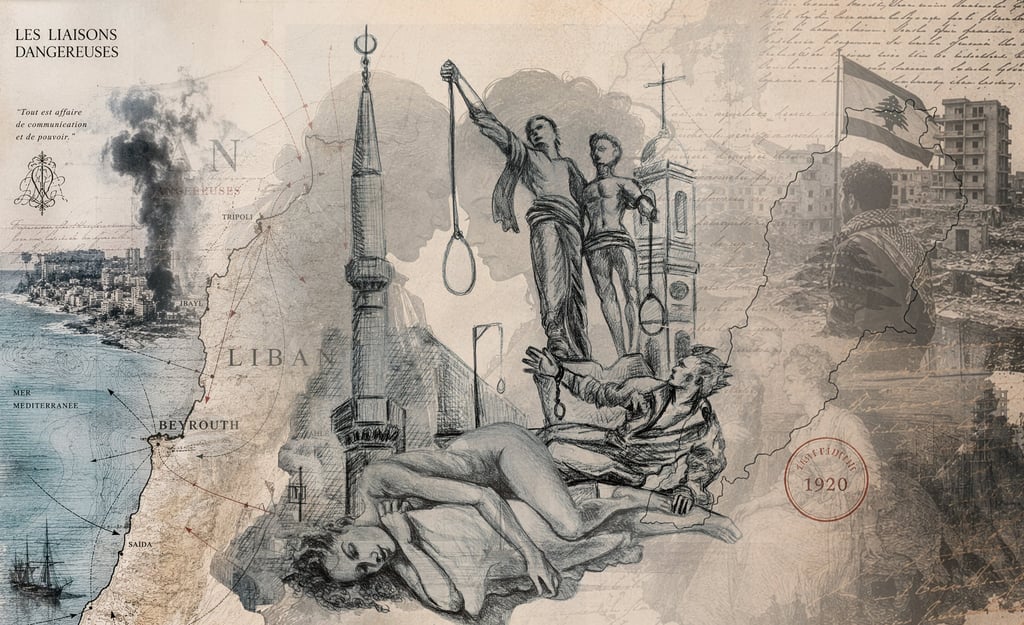
Guy Debord is remembered for saying that in a world turned upside down, the true is a moment of the false. This inversion is currently ubiquitous in the realm of geopolitics where organized crime is at the helm of the civilizational enterprise and liberation movements are promptly classified as terrorist. Objectivity has a surplus of what constitutes the reality of its participants, yet in a world full of serviceable objects, objectivity is hard to come by. If by its multi-faceted nature, objectivity carries the full range of the subjective realities, perspectives, and existential conditions of those who establish it — what phenomenologists call the "lifeworld" of its practitioners — the current political climate is instead dominated by powers with a narrative engrossed with itself to the point of obdurate exceptionalism. From the US empire and Zionist standpoints, it is a God-given right to exterminate entire populations. Since the world is what one makes of it, it is a duty to defeat adversity, to kill freely and with full detachment. The systematic targeting of journalists who can attest to the facts, of anyone able to verify their relentless aggression in Palestine and Lebanon, is doubled by a handy edit tool that forges their advantageous narrative and photoshops their spotless real-estate mirage. The rape hoax is still being perpetrated almost three years after October 7 to legitimize the genocidal intent of the Zionist occupation. The staggering triumphalism of the US war machine bent on declaring itself the winner in its war against Iran no matter the crushing evidence to the contrary. The extreme censorship Israel imposes on the casualties it incurs and the absolute silence of mainstream media about the successful retaliations of the resistance forces. All these grotesque distortions of verifiable facts come as no surprise when considering the inverted framework that holds entire populations hostage to the mendacious US-Israeli alliance. The inversion has no bottom with Iran using its influence to protect the sovereignty of Lebanon while the US brokers a peace treaty between its traitor president and Israel, when it has partnered in the aggression all along and with its vassal state, stands defenseless against the retaliation of Hezbollah and Iran. Flipping words around, all of what Joseph Aoun, the unconstitutional president on Washington’s payroll could ask of Israel is for "the power of reason to prevail over the reason of power."
The obsequiousness of the colonized, well identified by Frantz Fanon, refers to a psychological condition where colonized people internalize the colonizer's claimed superiority, adopting their values, aesthetics, and hierarchies while devaluing their own heritage. It manifests as deference toward the colonizer's culture, mimicry of their manners, and often contempt for neighboring colonized peoples who are seen as "more native" than oneself. Lebanon presents a crystalline case of this phenomenon, rooted in the French Mandate (1920–1943) and the particular stratification of Mount Lebanon's society. A significant segment of Lebanon's Christian bourgeoisie—and elements across sectarian lines—developed what Fanon called "white masks." This manifests as cultural distancing, the deliberate cultivation of “Phoenician identity” over Arab identity. While all Arab states engage in pre-Islamic heritage narratives, the Lebanese case often functions to distinguish Lebanon as essentially “Mediterranean” and “Levantine” rather than Arab—geographically in the Orient but civilisationally belonging to the Mediterranean world of Greece, Rome, and France. Not to mention linguistic hierarchy as among certain classes, French is not merely a second language but a class marker of cultivation. And predictably, a walk through certain quarters of Achrafieh or Downtown Beirut reveals the architectural and consumer manifestation of this psychology, where the reconstruction by Solidere under Rafic Hariri was explicitly modeled on Haussmann's Paris—a physical erasure of the Ottoman/Arab fabric in favor of a simulation of European modernity. The sorriest expression of this plight, to the exception of the Shiite south which is not surprisingly kept at bay, is that most Lebanese to this present day, identify with Europe and the USA significantly more than they are willing to nurture an affinity with Iran. The rabbit hole goes deeper, for while Iran’s power has been concretized, earning the respect it deserves among all the indigenous groups of the region, the leaders of a Christian minority are composing long sycophantic dithyrambs to Vice President JD Vance about the battered plight of their ancestral community which for countless reasons, the West has every interest to protect. Samir Geagea, President of the Lebanese Forces under whose umbrella, the Phalange (Kataeb party) perpetrated the 1982 Sabra and Shatila massacre, laps up to Washington with barely concealed sycophancy. Interminable appeals and fawning pleas to common-sensical values of, in the words of judge Peter Germanos, “freedom of conscience, pluralism, private property, education and human dignity.” For obvious yet well-guarded reasons, the redundant pleadings of these missives, testaments to the desperation of attaining a modicum of sovereignty in exchange of their sell-out, never once make a mention of Israel.
There is a false semblance of heterogeneity, the kind of diversity one gets in a shopping mall or when the head of the Lebanese Christian militia pretends to speak on behalf of the entire country. The Sykes-Picot agreement leaps forward in time to land on the battered riverbanks of the Litani. The resistance has barred the invasion of South Lebanon and is backed by Iran’s power ascendency in the region. But Israel is lashing out like a cornered beast, surrounded by a choir of Arab allies putting their foolish hatred of Hezbollah and Iran into manic chants. The valiant resistance group already flipped the script on the IDF, and extends a helping hand to the Lebanese government, beckoning it to benefit from its strength. But like pearls thrown to the swine, they fall on the deaf ears of a small minority, discretely supremacist, childish in its refusal of indigenous support and all the more enraged at the prospect of having no other choice. These are folks desperate to belong to an ancient heritage, ensconced in an illustrious past that wallpapers their profound denial. Their naïve trust in the reigning superpower is akin to the assumption that enough megapixels can turn an image into a living organism, and yet their deceiving candor hardly conceals the Kataeb’s vicious maneuvers, for if push came to shove, they would gladly trade the south of the country for a private enclave surrounded by the charms of a like-minded bourgeoisie, even if at the moment, it is fought as an enemy throughout the country. The US sports one of its biggest embassies down the street and for the time being, is asking Israel to curb its enthusiasm. That is why everything hinges on “the weapon” and its unequivocal removal, to wishfully make Hezbollah’s surrender perfectly match Israel’s retreat. These foolish traders of their own sovereignty, as in Laclos’ Les Liaisons Dangereuses, following the Marquise de Merteuil’s pragmatic advice on how to survive in a ruthless society, agree that “when it comes to marriage, one man is as good as the other, and even the least accommodating is less trouble than…” might we say, a motherland.
Colonial individuation is the process by which the indigenous population is trained to adjust to its cultural harness and ergonomic shackles. It is also the method that bestows a certain amount of autonomy from traditional structures, for a subject to become a well-adjusted, self-regulating agent able to hold an identity, career, and relationships. In the case of Lebanon, although the extended family is traditionally honored, society at large is divided along sectarian lines. A key to conditioning the cultural terrain is to prioritize the individual over societal concerns, fragmenting the ability of the collective to sustain any meaningful change. Arab culture, mocked by the West for putting the cart of the collective before the horse of individuality, had to be splintered into a cacophony of competing communities, with the sinister intent of having the Arabs do the damage to themselves. In order to suffocate dissent and keep all factions busy with endless diatribes and narrow concerns, competitive systems had to be deployed, breeding an obdurate type of personality. Ayn Rand is regarded as a champion of radical individualism. What has been referred to as her Objectivism, elevates rational self-interest to the highest moral purpose and makes the individual, the primary unit of ethical and political value, stigmatizing altruism and sacrifice for the group as reprehensible and immoral. Her ultimate goal of personal achievement and productivity, as in the case of Lebanon rests on a limited government that protects the rights of private property. And yet with the significant difference that the Lebanese version of the rugged individual, nursed on ideals of emancipation that mix the disingenuous naivete of the Americans with the pomposity of the French, developed on distinct sectarian faultlines. The colonial legacy of Lebanese individualism, ever since its 1926 constitution, institutionalized segregated power-sharing in a communal fragmentation masquerading as pluralism. The French mandate deliberately crafted the sectarian system, creating “Greater Lebanon” as a Maronite-dominated Christian state ensuring continued European influence by aiding commercial elites to seek Western acceptance over Arab solidarity, thus sacrificing social cohesion for colonial acceptance. It may seem like the Lebanese exercise of individualism is not exactly aligned with Rand’s vision of the sovereign individual which is transcendent to communalisms seeking colonial approval, that it is aspirational at best while her position emerges from the cultural confidence of American exceptionalism and Western achievements. The hollow individualism dependent on external validation is what Rand would call “second-handedness,” but blaming sectarianism for the failed exercise of individualism has the aberrant effect of corroborating the transcendence of the individual. Thus, the Lebanese internalize the skeletal structure of individualism as an ideal and let it hover weightlessly over the absence of sovereignty. The double-think of the colonized makes what is a given for Ayn Rand, a principle to look up to and a goal to be achieved, hence the decontextualized revindications of national independence by patriotic zealots, the insistence on a Lebanon that is free from all and any foreign influence, as if it were even possible for a country to exist in a political vacuum and to defend a nation in a stolid suspension of belief. National obsession is of course, delusional without regional awareness and ridiculous in its solipsistic insistence on “a country like any other, with control over its own borders and destiny.” The Parvenu is the bourgeoisie of the political stratification of Lebanon and the offspring of the sectarian patronage networks of Laissez-faire capitalism, with the additional requirement that whereas the rewards of empire are provided for Rand’s individual, the Lebanese has to assume them before acceding to a relative autonomy. And although sectarianism is a twisted expression of coerced diversity, casting it as the failure of the collective perversely makes it into the condition that legitimates the unrestricted supremacy of the individual. From their early age, the Lebanese are subjected to this overarching valorization of ostentatious individualization which has the nefarious effect of dismissing the calling for collective engagement and responsibility as purely idealistic. The increasing amour-propre in subsequent years gets levelled at the ones who cannot provide for themselves, the maladjusted in a common arena in which everyone must perform as a condition of survival.
The misuse of traditional idioms is characteristic of cultural colonization, well exemplified by the pejorative inflections given to Islamic expressions. Among them is “Tashbeeh” which in Lebanese slang turns the greeting to the glory of god into an instance of self-aggrandizement, an opportunity to show-off with the type of attention-seeking behavior known as “m’atuvuisme” (from m’as-tu vu, did you see me). “Inshallah,” the title of Oriana Fallaci’s 1990 novel about Italian peacekeeping soldiers during the 1983 civil war, reframes a sacred Islamic phrase through a lens of war, death and meaninglessness, reducing a complex spiritual concept into a symbol of Muslim irrationality. It parallels its profane devaluation in Lebanon, but while Fallaci imbues the expression of trust in divine wisdom with despair and nihilistic resignation, a usage rooted in the orientalist framework that defines her Islamophobic trajectory, the Lebanese slang flattens the providential dimension of “Inshallah” to load it with a flurry of sarcasm, like “Mashallah” which ironicizes the magnanimous greeting into a personal put-down. These idioms would automatically find a different inflection in a society that puts more emphasis on collective agency. The cult of individuality is akin to the same principle that separates nation-states from an expanded network of alliances and just like it, requires maintenance with infusions of positivism, promises of economic prosperity and false equality, while quite predictably, a breach in the structure of domination cannot be taken as an opportunity, a possible path to a shared confluence of freedom and responsibility but is quickly sealed by the moral turpitude of maintaining a universally ratified status-quo.
The Lebanese Authority has officially joined the ranks of the Palestinian Authority. Another document, short of a treaty, has been signed by the Lebanese government of Joseph Aoun and Nawaf Salam, recognizing the state of Israel to the wishful thinking of the US-Israeli coalition. It is not the first attempt at establishing an alliance with the Zionist state or keeping a safe distance with a hackneyed peace treaty, since there are pending resolutions from previous accords, and is only shocking in its disappointment, for while the opportunity for genuine redemption presents itself, at a time when the entire International community is keeping its distance from Israel, the collaborationist authority does the exact opposite. It is the tragic plight of the maiden who, seduced by her masters, snubs her true lover*(see note below). When the chance for happiness presents itself, the abused, accustomed to the mistreatment it has endured, shoots itself in the foot. As for the contested agreement, if it is not effectively “null and void,” it gives its supporters a reason to brag but the probability is that it will not stand. In the absence of Hezbollah at the unipolar “negotiating” table, the document has no bearing on the facts already established and developing on the ground. It does not initiate the historical change that its supporters are hailing as a victory but continues to litter social media platforms with an old anthem of submission. Directed at the MoU between the US and Iran to neutralize it, the hasty deal makes Lebanon, which was at the front and center of the initial agreement, the sacrificial scapegoat cast out in the desert of betrayal. To the short lived enthusiasm of its supporters, the treason begs the question of whether it is wide-eyed trust, logical deduction or pragmatic choice that justifies their capitulation. Is it just the adoption of an unquestioned edict, substantiated by flawed reasoning and biased observation that leaves Lebanon out to hang on a colonial clothesline, next to Palestine, flanked by two meaningless pieces of paper, to the three-partite denial of the monkey who sees no evil, hears no evil and speaks no evil.
*Note:
Concluding the analogy to Laclos’ plot, the Lebanese government is like Cécile de Volanges, the ingenue used as a pawn in the dark manipulative games between the Marquise de Merteuil, who ruins the young girl’s relationship to a former lover and tasks her womanizing partner in crime, the Vicomte de Valmont, with deflowering and corrupting her. Cécile falls for the vicious Vicomte, gets pregnant, and after a tragic turn of events, retreats to a convent and becomes a nun.
Explore the artworks
of Ely Tahan on social media:
CONTACT
© 2025. All rights reserved.